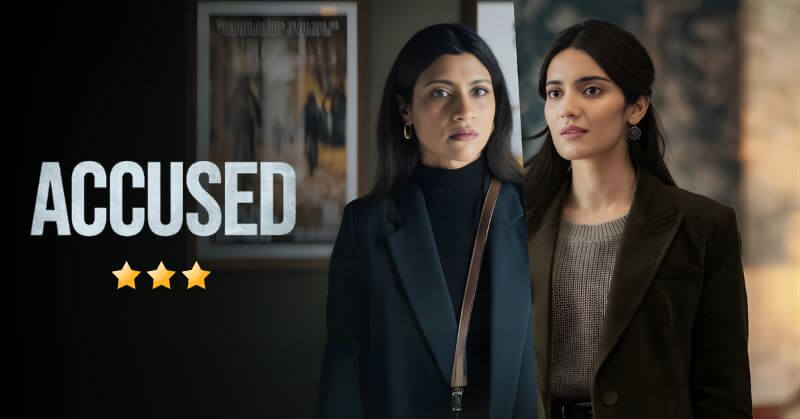
Anubhuti Kashyap’s Accused arrives with a bold premise and an even bolder casting choice. Led by Konkona Sen Sharma and Pratibha Ranta, the film dives into uncomfortable territory. It talks about power. It talks about reputation. And most importantly, it talks about how quickly society decides who is guilty. Set in London, the film unfolds like a psychological chamber drama rather than a conventional thriller. It is sharp in parts. It is restrained in others. And at its heart lies a question that keeps you thinking long after the screen fades to black. This is not an easy watch. Nor is it designed to be one. But it holds your attention.
Accused Story

The story revolves around Dr Geetika Sen, played by Konkona Sen Sharma. She is a respected doctor. She is successful. She becomes the first female Dean of her hospital. She is also in a same sex marriage with Dr Meera Mishra, portrayed by Pratibha Ranta. The two are planning to adopt a child and move ahead with their lives. Everything seems steady. Until it is not.
Geetika’s world begins to collapse when anonymous allegations of sexual harassment surface against her. What starts as a whisper soon turns into a public spectacle. More complaints begin to emerge. An official investigation is initiated. Media noise grows louder. Colleagues begin to distance themselves.

At home, things are not the same either. Meera, who once stood firmly beside her, starts to question parts of Geetika’s past. Trust begins to crack. Doubt seeps into their relationship. The film then moves into a tense zone where suspicion and emotional turmoil drive the narrative forward.
The core question remains simple yet disturbing. Is Geetika a victim of bias and prejudice? Or is she guilty of something she never expected to confront publicly?
The film stays focused and tightly structured within its 1 hour and 46 minutes runtime. It does not wander. It does not overcomplicate the plot. But it does leave you with moral discomfort.
Accused Movie Review

Anubhuti Kashyap makes a very conscious choice with this narrative. Instead of a powerful man being accused, here the accused is a woman. Not just a woman. A successful woman in a same sex marriage. That shift changes everything. It brings a fresh perspective to conversations around power and misconduct.
The film does not sensationalise the allegations. It observes them. It quietly examines how society reacts. The camera often lingers on silences. On awkward pauses. On faces that are unsure whether to believe or doubt. That restraint works.
The writing by Sima Agarwal and Yash Keswani attempts to layer morality in shades of grey. There is no clear black and white. That is a strong point. You are constantly evaluating what you see. However, the screenplay occasionally feels underwritten when it comes to backstory. Certain confrontations needed more emotional buildup. Some scenes pass too quickly without digging deeper.
The biggest issue lies in predictability. There comes a point where you think you know where the story is heading. And chances are, you might be right. When that happens, the tension drops slightly. The climax, especially after an intense buildup, feels a bit underwhelming. It does not explode. It settles. Whether that works depends on the viewer.
Technically, the film delivers a mixed bag. The cinematography is functional and controlled. It creates a closed and suffocating atmosphere, which suits the theme. The colour palette is dark and moody. At times, it feels slightly excessive, but it adds to the emotional weight. The sound design is subtle yet effective. Silence is used cleverly to heighten tension. Editing is crisp. The narrative never drags.
The background score remains minimal. It does not dominate scenes. Instead, it supports them quietly. This choice enhances the realism of the narrative. The production design feels authentic, especially in hospital and domestic settings.
Accused Performances
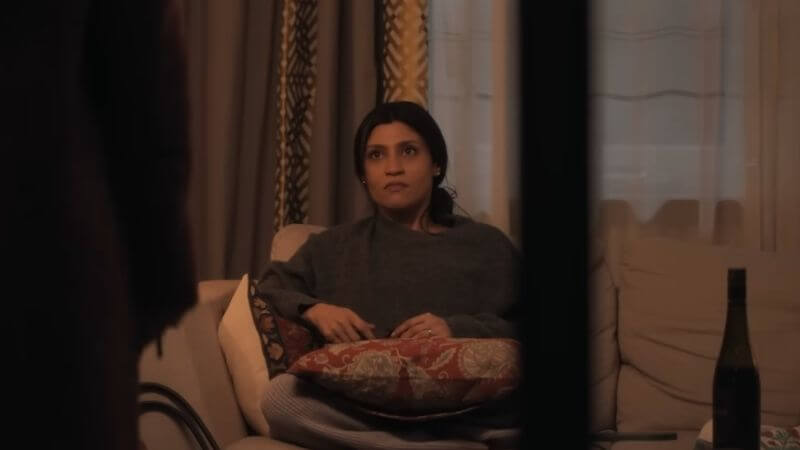
Konkona Sen Sharma once again proves why she is one of the finest actors we have. Her portrayal of Geetika is controlled and layered. She knows when to hold back. She knows when to show vulnerability. There are moments when you feel for her deeply. There are moments when you doubt her. And that balance is achieved beautifully. She never overplays her hand. Even when the character is cornered, she maintains restraint. That makes the emotional breakdowns more impactful.
Pratibha Ranta as Meera delivers a sincere performance. While her screen time is relatively limited, her presence matters. Her emotional conflict feels real. You can sense her confusion. You can sense her hurt. However, the character deserved more exploration. With stronger writing, Meera could have been even more powerful.
The supporting cast does a decent job. Monica Mahendru, as the HR representative, brings quiet authority. Mashhoor Amrohi, as the investigator, remains measured and composed. Sukant Goel, Aditya Nanda, and others fit naturally into the narrative without overpowering it. Overall, performances remain the film’s biggest strength.
Final Verdict

Accused is not a loud thriller. It is not packed with dramatic twists every ten minutes. Instead, it unfolds steadily. It questions the audience. It challenges perception. There are flaws. The climax lacks the punch one expects. The predictability reduces the shock value. But the film still works because of its premise and performances.
It speaks about powerful women being judged more harshly. It highlights how private lives become public debates overnight. This is a thoughtful drama that may not satisfy those expecting a high-octane courtroom thriller. But if you prefer layered storytelling and complex moral questions, you will appreciate what it attempts.
Rating: ⭐⭐⭐ (3/5)
Stay tuned with Cinetales for more deep dives into the latest movies, series, OTT drops, and box office battles — all in one place!
Follow Us: Facebook | Instagram | X |
Youtube | Pinterest | Google News |
Cinetales is on YouTube; click here to subscribe for the latest videos and updates.